
Pool stabiliser (cyanuric acid) dose calculator
Adding stabiliser is one of the most common pool dosing mistakes, too much, and you’re locked into chlorine lock for the rest of the season. The right dose is precise and depends only on your pool volume.
Last updated: 2 June 2026
Cyanuric acid (CYA), sold as “stabiliser”, “conditioner”, “pool conditioner”, or “isocyanurate”, is the chemical that protects your chlorine from UV degradation. Without it, summer sun destroys free chlorine in under two hours. With it, the same chlorine lasts 8–12 hours.
The dosing math is simpler than most pool chemistry, CYA isn’t pH-sensitive or temperature-sensitive, but the consequence of over-dosing is the most expensive in residential pools. Add too much CYA and you can’t remove it without partial draining. The full chemistry of chlorine lock is in our chlorine lock guide; this page is the dosing reference.
CYA dose math
Cyanuric acid in pool product form is sold as ~99% pure CYA. The math: 10 g of cyanuric acid per 1,000 L raises CYA by 10 ppm. Equivalently, 1 kg per 100,000 L raises CYA by 10 ppm.
Dose reference table
| Pool size (L) | +10 ppm | +30 ppm | +50 ppm | +70 ppm |
|---|---|---|---|---|
| Cyanuric acid dose (kg) to raise CYA | ||||
| 20,000 | 0.20 kg | 0.60 kg | 1.00 kg | 1.40 kg |
| 30,000 | 0.30 kg | 0.90 kg | 1.50 kg | 2.10 kg |
| 50,000 | 0.50 kg | 1.50 kg | 2.50 kg | 3.50 kg |
| 70,000 | 0.70 kg | 2.10 kg | 3.50 kg | 4.90 kg |
| 100,000 | 1.00 kg | 3.00 kg | 5.00 kg | 7.00 kg |
How to add stabiliser correctly
CYA is slow to dissolve and the dissolution method matters. Most “stabiliser problems” trace to incorrect addition:
- Do not pour granular CYA directly into the pool. Granules settle on the bottom, where they take days to dissolve. During that time, they can etch plaster or stain vinyl liner.
- Dissolve in a bucket of warm pool water first. Use 10 L of water per 500 g of CYA. Stir until fully dissolved, may take 20+ minutes.
- Alternative: dose via the skimmer. Add powder slowly into the skimmer while the pump is running. The pump filter holds the granules while water passes through, gradually dissolving them. Cleaner method for big doses.
- Pump must run continuously for 24 hours after addition.
- Re-test in 24 hours. CYA test results are unreliable for the first 6 hours after addition, let the chemistry settle first.
Don’t over-dose stabiliser. The only way to lower CYA is partial drain and refill. Adding 3 kg when you needed 2 kg means draining 30% of your pool to recover. Always under-dose first, test, add more if needed.
Target CYA by pool type
| Pool type | Target CYA | Why |
|---|---|---|
| Indoor pool | 0 ppm | No UV, CYA serves no purpose |
| Outdoor chlorine pool | 30–50 ppm | Balance: UV protection vs. chlorine lock risk |
| Outdoor saltwater pool | 60–80 ppm | SWG cells run continuously; higher CYA prevents UV outpacing the cell |
| Outdoor hot-climate pool (QLD/NT) | 50–70 ppm | Higher UV justifies slightly higher CYA |
| Spa (outdoor) | 20–30 ppm max | Spas use less chlorine per litre; low CYA is fine |
| Spa (indoor) | 0 ppm | No UV |
Sources of unintentional CYA addition
Many pool owners are surprised by their CYA levels because they “haven’t added stabiliser”. The unintentional sources:
- Trichlor tablets, 60% chlorine + 54% CYA by weight. 1 kg of trichlor adds 540 g of CYA.
- Dichlor granular shock, 62% chlorine + 57% CYA. 1 kg adds 570 g of CYA.
- “Stabilised chlorine” products, anything marketed as “long-lasting” or “won’t burn off in sun” contains CYA.
If you use trichlor tablets continuously, your CYA will climb roughly 30 ppm per month of summer use. From an October starting CYA of 30 ppm, you’ll hit chlorine lock zone (150+ ppm) by January without ever adding “stabiliser” as such.
Sources & references
- Trouble Free Pool, ABCs of Pool Water Chemistry
- Richard Falk, The Chlorine/CYA Relationship
- ANSI/APSP-11, Water Quality Standards in Public Pools
- AS 3633-1989, Private swimming pools (Australian Standard)
Frequently asked questions
How much stabiliser to add to a pool?
10 g of cyanuric acid per 1,000 L raises CYA by 10 ppm. So a 50,000 L pool needs 500 g (0.5 kg) per 10 ppm. Target CYA is 30–50 ppm for outdoor chlorine pools, 60–80 ppm for saltwater pools.
Can I add too much stabiliser?
Yes, and it’s the most expensive pool chemistry mistake. CYA doesn’t degrade, so the only fix is partial drain and refill. Always under-dose first (70% of calculated), test, then add more if needed.
How long does stabiliser take to dissolve?
20+ minutes to dissolve in a bucket of warm water. 24 hours to fully distribute and stabilise in the pool. Don’t test CYA within 6 hours of addition, readings will be unreliable until the chemistry settles.
Do I need stabiliser if I’m not using trichlor tablets?
If your pool is outdoors and chlorinated, yes. UV destroys unstabilised chlorine in ~2 hours. CYA is essential for keeping chlorine in the water long enough to sanitise. Use liquid chlorine + separately-added CYA stabiliser as the cleanest combination.
Does the Water Test Calculator app calculate stabiliser doses?
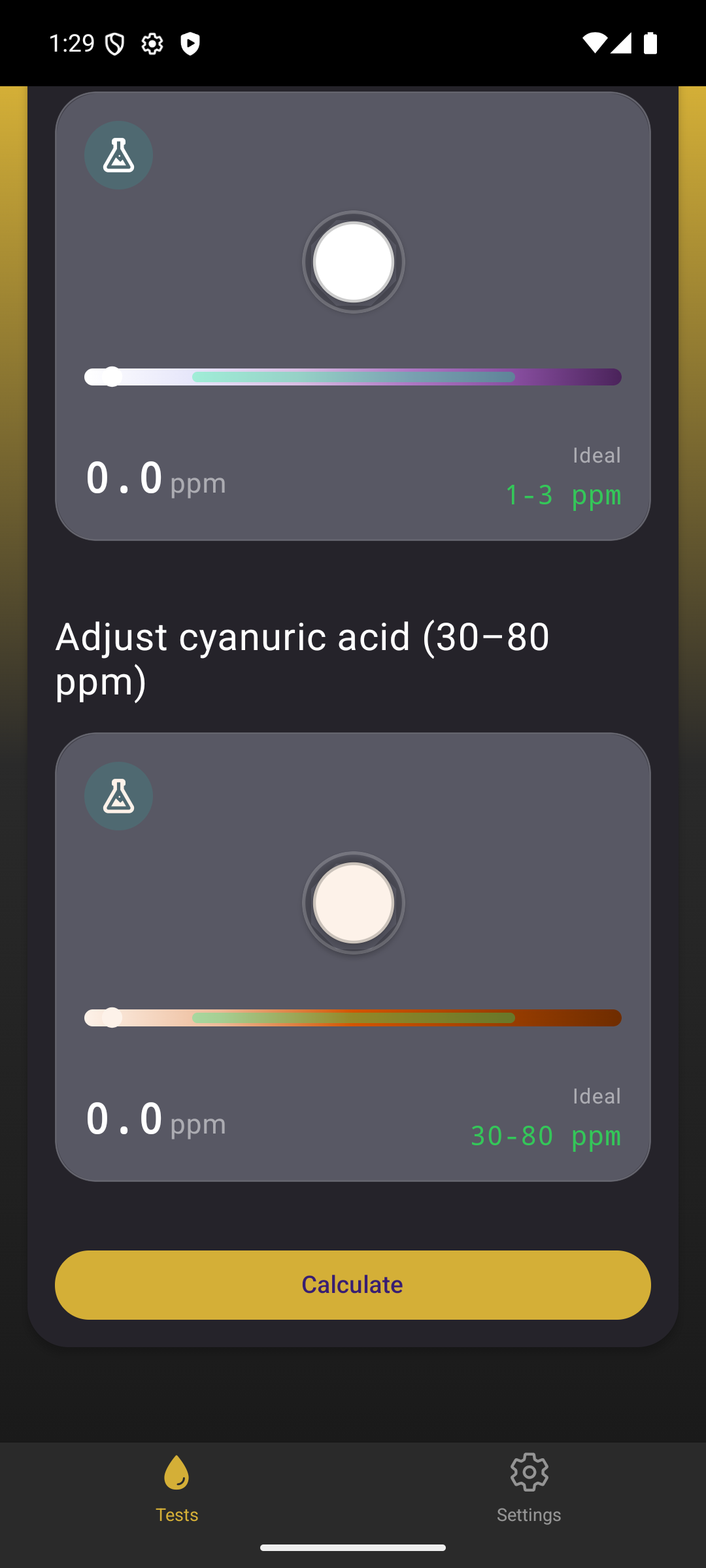
Yes. Enter your current CYA, target CYA, and pool volume, the app calculates exact CYA dose and warns before over-dosing. Launching on iOS and Android in approximately 10 days.
Get the launch alert + free checklist
Water Test Calculator launches on iOS and Android in ~10 days. Free with ads. Premium unlocks unlimited history, smart notifications, and ad-free testing.