
Last updated: 2 June 2026
“Shocking the pool” is one of those phrases that’s used loosely and means three different things to three different pool owners. Strictly, shocking a pool means raising the free chlorine to break-point chlorination, the level at which combined chlorine (chloramines) is oxidised completely and your sanitiser returns to a clean baseline. Anything less than that isn’t shocking; it’s just adding more chlorine.
The reason this matters: most “shock” advice you’ll read tells you to add a fixed amount per 10,000 gallons regardless of your pool’s cyanuric acid level. That’s wrong, and it’s the most common reason pools “shock” but don’t actually clear up.
What break-point chlorination actually is
When free chlorine reacts with organic matter (sweat, urine, sunscreen, dead skin cells, leaves), it forms combined chlorine, chloramines. Chloramines are the source of “pool smell” and eye-sting, and they’re significantly less effective as sanitisers than free chlorine.
At low free-chlorine levels, the chloramines persist. At a high-enough free chlorine level, they’re oxidised completely, broken down into nitrogen gas, water, and chloride. That threshold is break-point chlorination, and it’s specifically 10× your combined chlorine reading.
So if your test shows total chlorine 4 ppm, free chlorine 2 ppm, your combined chlorine is 2 ppm. Break-point = 20 ppm. That’s the shock target. Adding just 5 ppm of chlorine moves you closer but doesn’t break the bond. The chloramines persist, the pool smell persists, the eye-sting persists.
The CYA-shock relationship most apps get wrong
Break-point math is more complicated when you have cyanuric acid in the water, and almost all outdoor pools do. CYA binds chlorine. The 10× rule still applies, but it applies to active chlorine, not measured free chlorine. With CYA in the system, the actual measured FC you need to hit break-point is roughly:
Shock target free chlorine = max(10 × combined chlorine, 40% of CYA)
, Trouble Free Pool community, derived from the Pickens-method chlorine/CYA chemistry research
So if your CYA is 60 ppm, your shock target is at least 24 ppm free chlorine, even if your combined chlorine is only 1 ppm. The 10×CC rule alone would have you shocking to just 10 ppm, not enough to break the chloramines effectively because of CYA-bound inactive chlorine. The full chemistry is laid out in our chlorine lock guide.
The single most common shock mistake: dosing for a “shock level” of 10 ppm in a pool with CYA above 50 ppm. The 10 ppm isn’t wrong as a base, it’s just inadequate for a stabilised pool. You need 40% of CYA at minimum, and usually 1.5× that to clear stubborn chloramines.
The three shock product options
Three commonly-available chlorine products work for shocking. Each has different math:
| Product | Chlorine % | Adds CYA? | Australian dose for 10 ppm FC in 50,000 L |
|---|---|---|---|
| Liquid chlorine (sodium hypochlorite) | 12.5% | No | ~4 L |
| Cal-hypo granular (calcium hypochlorite) | 65% | No | ~770 g |
| Dichlor granular | 62% | Yes (~57% by weight) | ~800 g (adds ~9 ppm CYA) |
| Trichlor tablets | 90% | Yes (~54% by weight) | Not recommended for shocking |
For shock specifically, liquid chlorine is the cleanest choice, it adds free chlorine and nothing else. Cal-hypo works but raises calcium hardness over time. Dichlor adds significant CYA with every shock, fine occasionally, problematic if you’re shocking weekly. Avoid trichlor tablets for shocking entirely, they’re slow-dissolving and add CYA disproportionately.
When to actually shock
Three legitimate reasons to shock a pool:
- Combined chlorine ≥ 0.5 ppm. The threshold where chloramines are causing irritation or odour. Test with FAS-DPD if possible (Taylor K-2006 or similar).
- Post-event: Pool party (10+ swimmers), heavy thunderstorm, accidental contamination event, or any time water is visibly cloudy.
- Algae appearance. Any visible green tint, even faint, even at “good” free chlorine readings, indicates the pool is losing the sanitation race. Shock + filter run 24 hours.
Shocking “preventively” every week regardless of need is mostly chemical-industry-driven advice. If your CC and visual readings are good, weekly shocks are unnecessary chlorine consumption and unnecessary CYA addition (if using dichlor). Shock when there’s a measurable reason.
A real-world worked shock example
50,000 L outdoor pool, post-thunderstorm Sunday morning, six guests swam Saturday evening. Test results:
- FC: 1.5 ppm
- TC: 4.0 ppm → CC = 2.5 ppm (high)
- CYA: 50 ppm
- pH: 7.6 ✓
- TA: 100 ppm ✓
Calculating the shock target:
- 10 × CC = 25 ppm
- 40% of CYA = 20 ppm
- Shock target = max(25, 20) = 25 ppm free chlorine
To go from FC 1.5 → 25 ppm: need to add 23.5 ppm of free chlorine. For 50,000 L of water using 12.5% liquid chlorine, that’s approximately 9.4 L of liquid chlorine.
Add over 30–60 minutes across the pool’s return jets with the pump running. Don’t dump it all in one spot, concentrated chlorine can bleach the liner. Re-test in 4 hours: FC should be near 25 ppm, CC should be dropping toward zero. By 12 hours, CC should be at or below 0.5 ppm and FC will have decayed to perhaps 8–10 ppm.
Don’t swim until the FC returns to safe range, wait for FC to drop below ~10 ppm. With CYA at 50 ppm, that’s safe (target FC for daily swimming is 4–5 ppm at CYA 50). Test before re-opening the pool.
The most common shock-related mistakes
| Mistake | Why it’s wrong | What to do instead |
|---|---|---|
| Shocking without testing CYA first | The shock target depends on CYA. Without it, you’re guessing. | Always test CYA before computing shock dose. |
| Using trichlor tablets to “shock” | Trichlor dissolves too slowly to hit break-point quickly, and dumps CYA into the water. | Liquid chlorine or cal-hypo for shocks. |
| Shocking every week as routine | Wastes chemistry and adds CYA if dichlor is used. | Shock when CC ≥ 0.5 ppm or post-event. Not as routine. |
| Shocking and immediately back-filling chlorine before testing | You don’t know if the shock worked. | Test FC + CC 12 hours after shocking. If CC isn’t below 0.5, shock again before adding anything else. |
| Shocking when CYA is above 100 ppm | You’d need 40+ ppm FC, which is functionally impossible to maintain. | Partial drain first. Reduce CYA. Then shock if needed. |
Sources & references
- Trouble Free Pool, ABCs of Pool Water Chemistry (community-developed reference based on the Pickens method)
- Richard Falk, “The Chlorine/CYA Relationship” (the seminal Pickens-method analysis)
- ANSI/APSP-11, Water Quality Standards in Public Pools (Association of Pool & Spa Professionals)
- AS 3633-1989, Private swimming pools (water quality) (Australian Standard)
Frequently asked questions
How much shock does my pool need?
It depends on three things: pool volume, combined chlorine, and CYA. The formula is: shock target FC = max(10 × combined chlorine, 40% of CYA). For a 50,000 L pool with combined chlorine 2 ppm and CYA 60 ppm, the shock target is 24 ppm free chlorine, which is about 9 L of liquid chlorine.
Can I shock a saltwater pool?
Yes. Most saltwater chlorinators have a ‘boost’ or ‘super-chlorinate’ mode that runs the cell at 100% output for 24 hours to deliver shock-level free chlorine. For faster results or higher CYA pools, supplement with liquid chlorine added manually.
How long after shocking can I swim?
Wait until free chlorine drops below 10 ppm for chlorine pools (or below 8 ppm for spas). With CYA in the pool, this is typically 4–8 hours after shocking. Test before re-opening, don’t rely on time alone.
Is shocking every week necessary?
No. Routine weekly shocking is mostly chemical-industry marketing. Shock when combined chlorine is 0.5 ppm or above, after pool parties, after heavy storms, or when you see early algae. Otherwise, regular FC maintenance prevents the need.
What’s the difference between regular chlorine and shock?
Chemically, very little. Most ‘shock’ products are just concentrated chlorine, either cal-hypo, dichlor, or liquid sodium hypochlorite. What makes it ‘shocking’ is the dose level (raising FC to 10×CC or 40% of CYA, whichever is higher), not the product.
Can I just leave the pump running instead of shocking?
No, filtration removes particulates but doesn’t break chloramines. You need free chlorine at break-point level to oxidise combined chlorine. Filtration helps clear the pool faster after shocking but isn’t a substitute for the shock itself.
Does the Water Test Calculator app calculate shock doses?
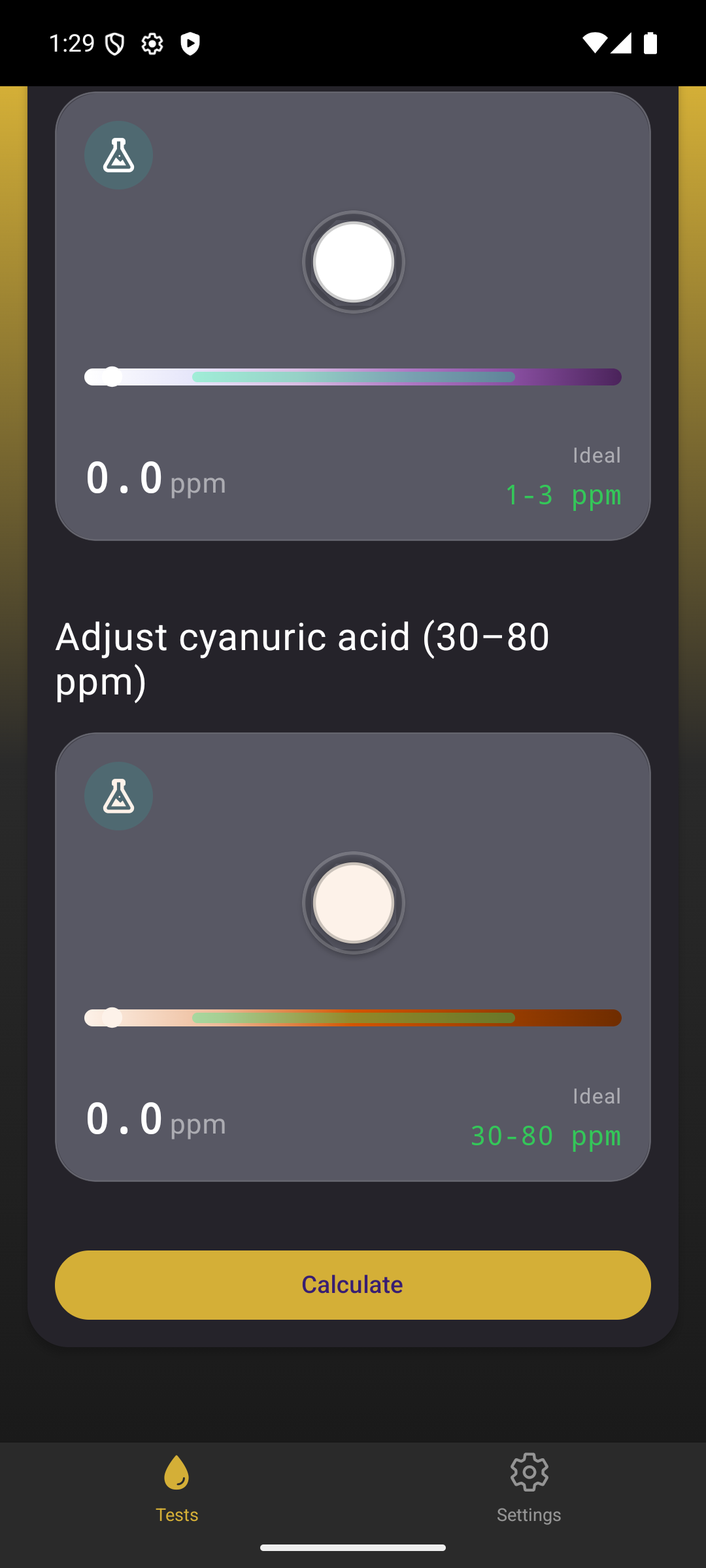
Yes. The app’s shock calculator auto-targets based on your CYA reading rather than a fixed value, and recommends the exact dose of your preferred chlorine product. It accounts for the CYA × 0.40 minimum and the 10 × CC requirement automatically. Launching on iOS and Android in approximately 10 days.
Pool shock dose calculator, the right way
Most shock calculators ignore your CYA level. That’s why pools keep going green even after shocking. Water Test Calculator auto-calculates the correct shock target based on your stabiliser level, preventing chlorine lock.
Launching in 10 days, be first in
Free with ads. Premium unlocks unlimited test history, smart notifications, and ad-free testing.