
Last updated: 2 June 2026
Every chemistry calculation in your pool, chlorine doses, salt additions, pH corrections, shock treatments, starts with one number: your pool’s water volume. Get the volume wrong by 10%, and every chemical dose you compute from it is wrong by 10%. Get it wrong by 30% (a common error for kidney-shaped pools), and you’re either chronically under-dosing or wasting chemicals on every adjustment.
The frustrating part: most pool owners don’t actually know their pool’s volume. Builder paperwork gets lost, the previous owners didn’t measure, and the value on the back of the pool’s pump motor refers to flow rate, not capacity. This guide walks through the math for each common pool shape, with worked examples and the common measurement mistakes that cause people to be confidently wrong about their pool’s capacity.
The four common pool shapes and their volume formulas
Every residential pool is some combination of these four shapes. Volume in litres = (area in m²) × (average depth in m) × 1,000.
Rectangular
The easy case. Volume = length × width × average depth × 1,000.
Worked example: A 10 m × 4 m rectangular pool with a depth that varies from 1.2 m at the shallow end to 2.0 m at the deep end. Average depth = (1.2 + 2.0) ÷ 2 = 1.6 m. Volume = 10 × 4 × 1.6 × 1,000 = 64,000 L.
Circular
Volume = π × radius² × average depth × 1,000. Where radius = diameter ÷ 2.
Worked example: A 5 m diameter circular plunge pool, 1.4 m deep throughout. Radius = 2.5 m. Volume = 3.14159 × 2.5² × 1.4 × 1,000 = 27,489 L. Round to 27,500 L for chemistry.
Oval (elliptical)
Volume = π × (length ÷ 2) × (width ÷ 2) × average depth × 1,000.
Worked example: A 9 m × 4.5 m oval pool, average depth 1.6 m. Volume = 3.14159 × 4.5 × 2.25 × 1.6 × 1,000 = 50,894 L. Round to 51,000 L.
Kidney
The hard one. Kidney pools approximate an oval with a “bite” taken out, usually 10–15% of the equivalent oval’s area. The simplest accurate formula is to calculate the oval volume of the kidney’s bounding rectangle, then multiply by 0.85.
Worked example: A kidney pool that fits within a 10 m × 5 m rectangle, average depth 1.5 m. Treat as an oval: 3.14159 × 5 × 2.5 × 1.5 × 1,000 = 58,905 L. Then × 0.85 for the kidney correction = 50,069 L. Round to 50,000 L.
Tolerance reality check: Pool chemistry doses are forgiving to about ±5% on volume. If your real pool is 50,000 L and you compute 47,500 L, every dose you calculate will be 5% under. Over a season, this manifests as slightly faster algae growth or slightly more frequent shock requirements. Annoying, not catastrophic. ±15% starts to cause real problems, chronic chlorine demand, persistent algae, scale build-up.
How to measure average depth correctly
The single most common volume mistake is using the wrong average depth. Three rules:
- If the pool slopes gradually from shallow to deep: average = (shallow + deep) ÷ 2. Works for most lap-style pools.
- If the pool has a flat shallow section and a slope to the deep end: the average is more like 60% of the depth difference, not 50%. A 1.2 m → 2.0 m pool with a flat shallow shelf has an average closer to 1.5 m, not 1.6 m.
- If you’re unsure, measure depth at five points (each corner + centre) and average. Use a weighted line dropped from the surface to the floor with the water level marked.
The unit conversion that trips people up
Australian pool literature uses litres. US pool literature uses gallons. Australian chemicals are usually priced and dosed per litre of pool water. Mixing the two is the most common dosing error I see, someone reads a US guide that says “add 1 lb of chlorine per 10,000 gallons”, converts the pool volume to gallons in their head, then doses Australian product to that math. The result is usually 5× the right amount.
The conversions:
- 1 US gallon = 3.785 litres
- 1 imperial gallon = 4.546 litres (rare in pool chemistry, but used in some old UK guides)
- So 10,000 US gallons = 37,850 litres = roughly a 38,000 L pool
Always convert both the pool volume and the chemical dose if you’re using a non-Australian source.
What the Water Test Calculator app does with your volume
Once. You measure your pool once, enter the volume into the app, and the app remembers it forever. Every test, every chemical recommendation, every shock dose calculation from then on uses your pool’s actual volume, not a generic “100,000 L” default that’s wrong for 90% of pools. For multi-pool households (pool plus spa is common in Australia), each profile stores its own volume.
The app’s four-shape volume calculator handles rectangular, circular, oval, and kidney pools, and stores the result on first use. From the second time you open the app onward, you never enter a volume again, your readings just get the right math automatically.
Sources & references
- Trouble Free Pool, ABCs of Pool Water Chemistry (community-developed reference based on the Pickens method)
- ANSI/APSP-11, Water Quality Standards in Public Pools (Association of Pool & Spa Professionals)
Frequently asked questions
Why does pool volume matter so much for chemistry?
Every chemical dose recommendation in pool chemistry is per litre of water. If you have 50,000 L of water but you’ve calculated 40,000 L, every chlorine dose, every salt addition, every pH adjustment will be 20% under what your pool actually needs. The chemistry doesn’t fail catastrophically, it just chronically under-performs.
How accurate does my pool volume estimate need to be?
±5% is the practical tolerance for residential chemistry. ±15% is the threshold where you’ll start seeing chronic problems like persistent algae or scale. Most owners who measure carefully end up within ±5%. The exception is kidney pools, where the bite-out correction is easy to get wrong by 10%+.
My pool builder gave me a volume, should I trust it?
Builder volumes are often nominal, they’re based on the pool’s outer dimensions, not the actual water-holding capacity. Steps, swim-outs, sun-shelves, and tile lines all reduce real water volume by 5–10% below the builder’s stated number. Re-measure if you want chemistry accuracy.
What’s the average depth of a typical Australian pool?
Most domestic Australian pools have an average depth between 1.3 m and 1.6 m. A ‘play pool’ with a flat 1.2 m bottom across the whole pool sits at the shallow end of typical. A traditional shallow-end-to-deep-end pool with 1.0 m → 2.0 m sloping averages around 1.5 m.
Does the swim-out or beach entry count toward pool volume?
Partially. The water volume above a swim-out shelf still holds chemistry, but the shallower water above it is a smaller fraction of the total. If your pool has a large beach entry (20% of the surface area at 0.3 m depth), expect to reduce the volume calculation by 5–10% from a simple length × width × depth calc.
Can I just measure the pool water meter when filling?
Yes, and this is the most accurate method available. Most Australian properties have a separate pool fill meter (or you can read the main meter before and after filling). The result is exact, and is what your pool actually holds. Worth doing once at fill or after a major drain to validate your math.
Does the Water Test Calculator app calculate volume for me?
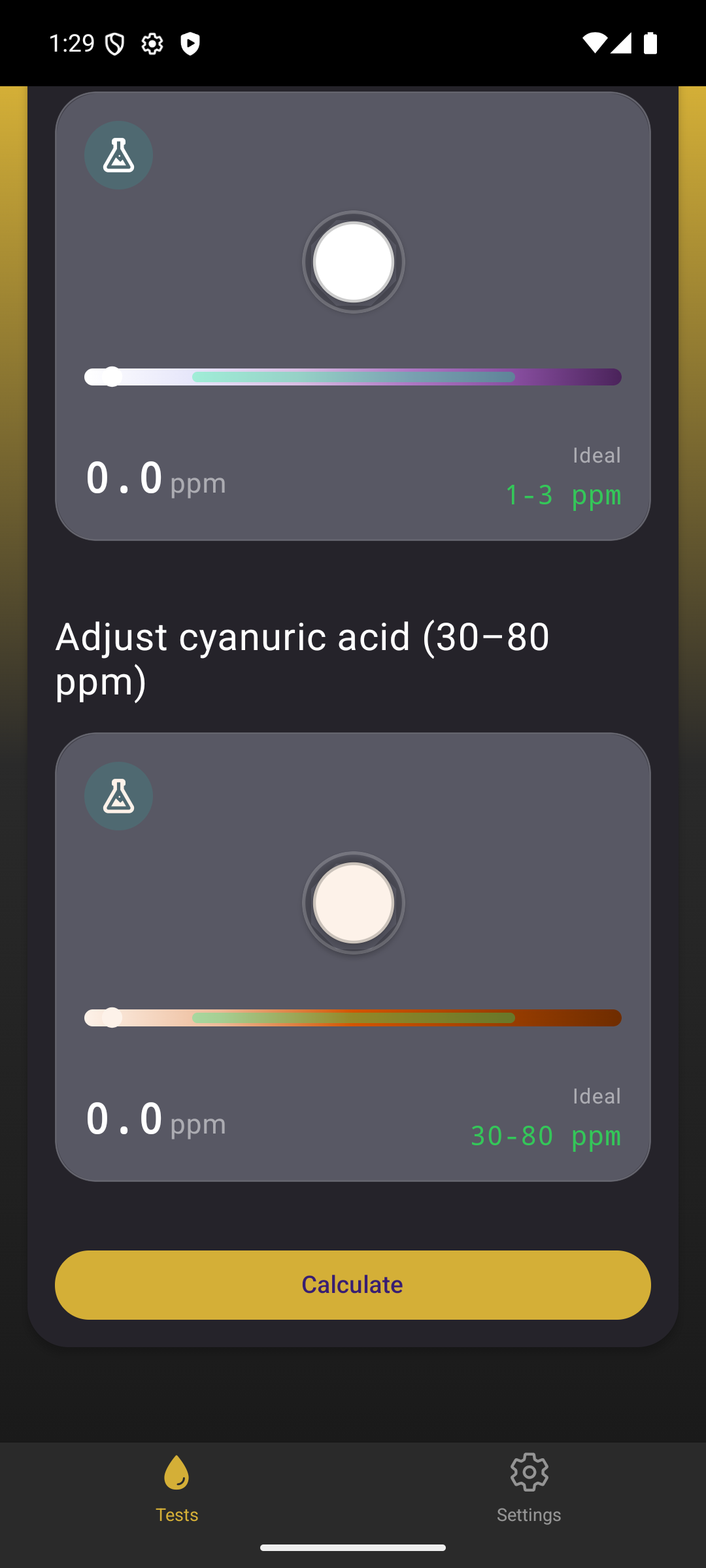
Yes. The app has a built-in calculator for the four common pool shapes (rectangle, circular, oval, kidney) and remembers your result. After the first use, every chemistry recommendation in the app uses your actual pool volume automatically. Launching on iOS and Android in approximately 10 days.
How to calculate your pool’s water volume
Rectangle, circular, oval, or kidney, Water Test Calculator calculates the exact volume for any pool shape and remembers it forever. No more re-entering measurements every time.
Launching in 10 days, be first in
Free with ads. Premium unlocks unlimited test history, smart notifications, and ad-free testing.